By need
Most accurate blood pressure monitors
"Accurate" has a specific meaning here: the model appears on an independent validation registry, and it takes the reading in a way that reduces noise. These picks do both — and we're clear about which registry each one is on.
Accuracy at home comes down to three things you can actually check: independent validation, a cuff that fits your arm, and consistent technique. The monitor can only control the first. A validated device with the wrong-size cuff still reads wrong.
Two registries matter in the US. validatebp.org is run by the AMA; STRIDE BP is the ESH·ISH·WHL list. Several good models sit on one but not the other — we never imply an AMA badge where there isn't one.
The single most useful accuracy feature is auto-averaging: the monitor takes three readings a few seconds apart and reports the average, which is how a clinic does it. The Omron 10 Series does this automatically.
What "validated" really means
A validation listing means an independent group tested the device against a reference standard and it passed. It is not the same as FDA clearance, which most monitors have and which speaks to safety, not reading accuracy.
- On both registries (AMA + STRIDE): Omron 10 Series, Omron Complete, A&D Medical UA-651, Withings BPM Connect.
- AMA-listed: Omron 5 Series, Omron Silver, Omron 3 Series, Greater Goods Bluetooth.
- STRIDE-only (not on the US AMA list): iHealth Track — a fine device, but if your clinic insists on an AMA-listed unit, choose an Omron or the A&D.
Why cuff fit changes the number
A cuff that is too small squeezes harder and can read falsely high; too large can read low. Measure your upper arm at the midpoint, relaxed. Every upper-arm model here ships with a wide-range cuff (about 22–42 cm); the iHealth Track reaches 48 cm. Match the cuff to your arm before you compare anything else.
The feature that steadies your reading
Blood pressure bounces from beat to beat, so a single reading is noisy. Averaging several readings gives a number you can actually track over time.
- Omron 10 Series (TruRead): takes three readings automatically and reports the average — no counting or math on your part.
- On other models you can do this by hand: take three readings a minute apart and average them yourself.
Technique beats hardware
Even the best-validated monitor reads wrong if the basics slip. This is device usage, not medical advice: sit with your back supported and feet flat, arm resting at heart height, and stay still and quiet during the reading. Do it at the same times each day. If a reading looks off, wait a minute and repeat rather than chasing it.
Worth knowing: No home monitor replaces your clinic. Bring your device to an appointment once so a nurse can check it against theirs on your arm — that's the real accuracy test.
Our picks
 Best overall
 Omron 10 Series
The all-rounder to beat: it takes three readings and averages them automatically (how a clinic does it), stores two users, and carries both the AMA and STRIDE validation listings. Reviewers find little to fault.
- Auto-averages 3 readings for a steadier number
- Listed on both major validation registries
- Two users, 100 readings each, on the device
Not for: The pre-formed cuff can be fiddly to position on very small or very large arms.
 Easiest to use
 A&D Medical UA-651
A clinic-grade brand at a drugstore price. No app, no clutter — one button, a big readout and a validation listing on both registries. The purist’s pick, and a great one for a parent who just wants the number.
- Brand widely used in clinical settings
- Genuinely one-button simple
- On both major validation registries
Not for: No app in this version; single-user memory only.
 Best for AFib screening
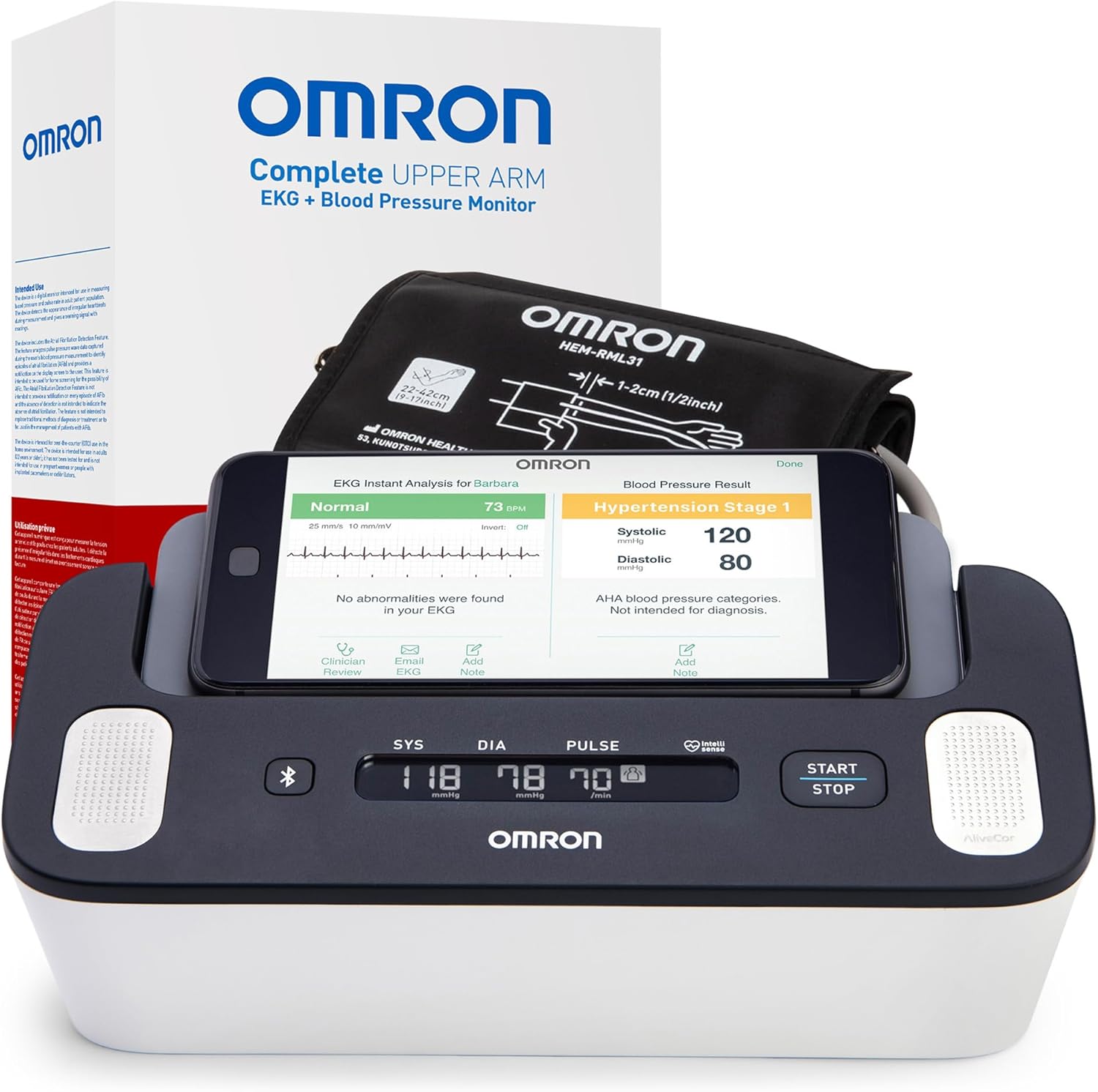
 Omron Complete
The only mainstream monitor that captures a validated blood-pressure reading and a single-lead EKG in one sitting. For people specifically told to watch for an irregular rhythm — read our note on what an EKG screen can and can’t tell you.
- Blood pressure + single-lead EKG together
- On both major validation registries
- EKG results viewable and shareable in-app
Not for: Pricey, and Bluetooth pairing draws recurring complaints. EKG is a screening aid, not a diagnosis.
 Best for travel
 Withings BPM Connect
The best-connected, best-travelling monitor here: validated, rechargeable, tubeless, and syncs over Wi-Fi with a genuinely good tracking app. Buy it for the software — the tiny device screen is the trade-off.
- Syncs over Wi-Fi with no base unit or cables
- Rechargeable — no battery swapping
- Excellent long-term trend app
Not for: Only ~8 readings live on the device — it leans on the app; the small screen is hard for older eyes.
Questions people ask
Is a more expensive monitor more accurate?
No. A validated $35 monitor gives the same trustworthy reading as a $140 one. Extra money buys features — an EKG, two-user memory, apps, a bigger screen — not a better number.
Are wrist monitors as accurate as arm cuffs?
Upper-arm cuffs are generally the more reliable choice for home use, and every monitor we recommend is an upper-arm model. Position matters a great deal on the wrist, which adds a way to get it wrong.