Buyer’s guide · updated August 2026
The best blood pressure monitors for 2027
We ranked 9 home monitors by the thing that matters most — an independent validation listing — then by cuff fit, how readable the numbers are, and how simple each one is to use. Every pick here is an upper-arm cuff on at least one public validation registry.
At a glance
- Omron 10 Series — Best overall
- Omron 5 Series — Upper-arm cuff, $55
- Greater Goods Bluetooth Monitor — Best value
- A&D Medical UA-651 — Easiest to use
- Omron Silver — Upper-arm cuff, $45
- Omron Complete — Best for AFib screening
- iHealth Track — Best for large arms
- Withings BPM Connect — Best for travel
- Omron 3 Series — Upper-arm cuff, $40
 Best overall
 Omron 10 Series
The all-rounder to beat: it takes three readings and averages them automatically (how a clinic does it), stores two users, and carries both the AMA and STRIDE validation listings. Reviewers find little to fault.
- Auto-averages 3 readings for a steadier number
- Listed on both major validation registries
- Two users, 100 readings each, on the device
Not for: The pre-formed cuff can be fiddly to position on very small or very large arms.

Omron 5 Series
The sweet spot for one person: genuinely one-button, a comfortable wide cuff, AMA-validated, and app sync if you want it — without paying for two-user memory you won’t use.
- One of the simplest monitors to operate
- Wide cuff included at a mid price
- App sync for sharing with a doctor
Not for: Single-user memory and a plain, unlit display — couples should step up to the 10 Series.
 Best value
 Greater Goods Bluetooth Monitor
The value surprise, and a repeated Wirecutter pick: a big, high-contrast backlit display and app sync at a budget price, AMA-validated, from a US brand known for responsive support.
- Big, easy-to-read backlit numbers
- Costs like a basic unit but syncs to a phone
- AMA-validated at a budget price
Not for: Smaller support ecosystem than Omron, and the app is basic.
 Easiest to use
 A&D Medical UA-651
A clinic-grade brand at a drugstore price. No app, no clutter — one button, a big readout and a validation listing on both registries. The purist’s pick, and a great one for a parent who just wants the number.
- Brand widely used in clinical settings
- Genuinely one-button simple
- On both major validation registries
Not for: No app in this version; single-user memory only.

Omron Silver
Omron’s big-numbers budget model: an extra-large display and the brand’s validated platform, for well under the 10 Series. If readability on a budget is the priority, this and the Greater Goods are the two to weigh.
- Extra-large, easy-to-read digits
- AMA-validated Omron platform
- 3-year warranty
Not for: Single line, no backlight; one-user memory only.
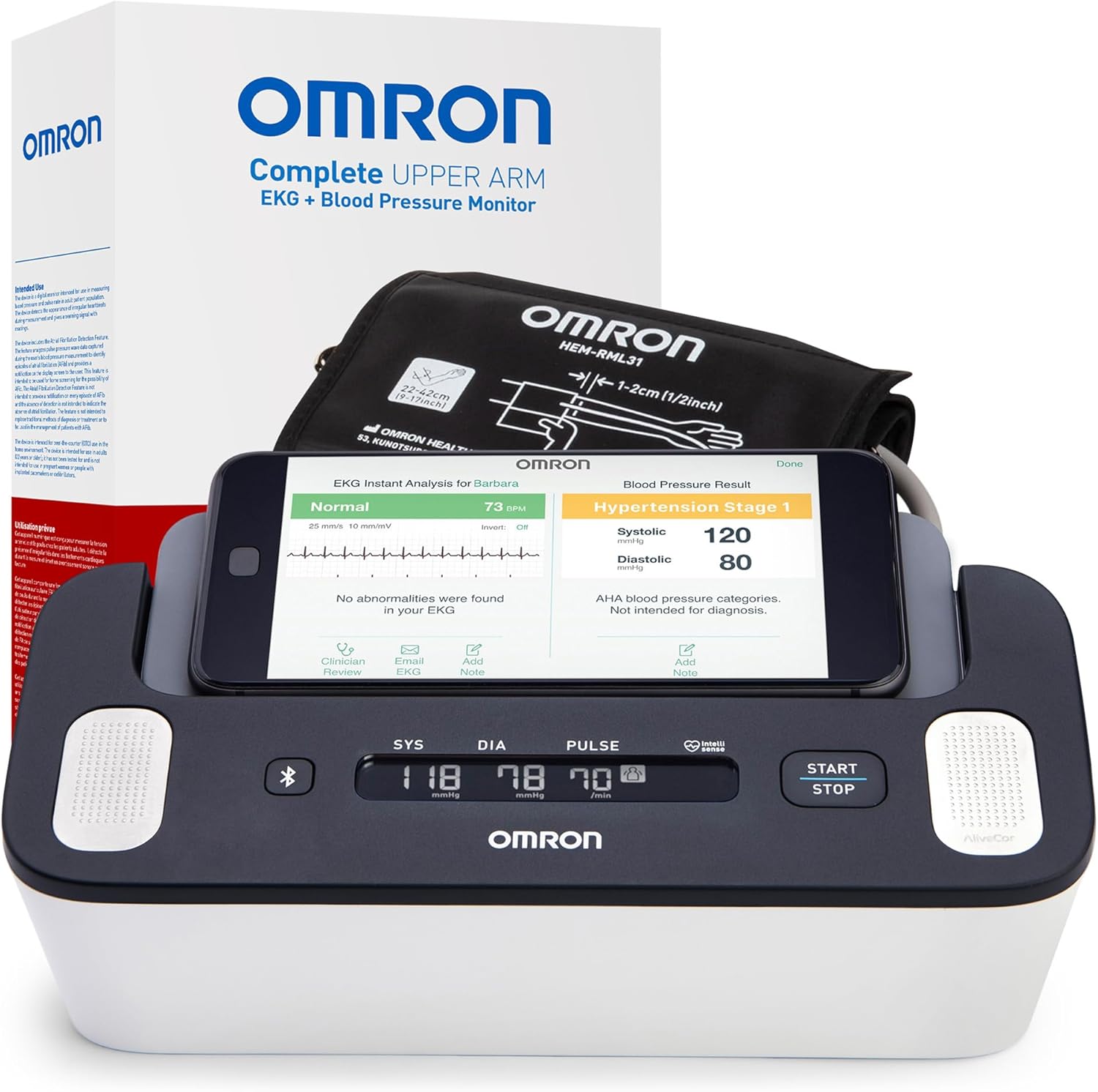 Best for AFib screening
 Omron Complete
The only mainstream monitor that captures a validated blood-pressure reading and a single-lead EKG in one sitting. For people specifically told to watch for an irregular rhythm — read our note on what an EKG screen can and can’t tell you.
- Blood pressure + single-lead EKG together
- On both major validation registries
- EKG results viewable and shareable in-app
Not for: Pricey, and Bluetooth pairing draws recurring complaints. EKG is a screening aid, not a diagnosis.
 Best for large arms
 iHealth Track
The answer when a standard cuff won’t close: a 48 cm range, a big backlit screen and a tidy app, for budget money. It’s validated by STRIDE BP (not the US AMA list) — we tell you that up front so you can decide.
- Fits arms up to 48 cm — best here for large arms
- Large, color-lit display
- Inexpensive entry to connected tracking
Not for: STRIDE-validated but not AMA-listed — noted plainly. Doctors who insist on a VDL device should pick an Omron or A&D.
 Best for travel
 Withings BPM Connect
The best-connected, best-travelling monitor here: validated, rechargeable, tubeless, and syncs over Wi-Fi with a genuinely good tracking app. Buy it for the software — the tiny device screen is the trade-off.
- Syncs over Wi-Fi with no base unit or cables
- Rechargeable — no battery swapping
- Excellent long-term trend app
Not for: Only ~8 readings live on the device — it leans on the app; the small screen is hard for older eyes.

Omron 3 Series
The no-frills Omron: same validated core, no phone pairing to fight with. If you just want a trustworthy number and a big button, this is the honest floor of the range.
- Cheapest way into the validated Omron platform
- Nothing to pair or charge
- Wide cuff still included
Not for: Stores only 14 readings; no app or Bluetooth.
Compare every monitor
| Monitor | Overall | Validation | Cuff | Connect | Users | Price |
|---|---|---|---|---|---|---|
| Omron 10 Series | 8.3 | ✓ listed | 22–42cm | BT | 2 | $75 |
| Omron 5 Series | 8.1 | ✓ listed | 22–42cm | BT | 1 | $55 |
| Greater Goods Bluetooth Monitor | 8.1 | ✓ listed | 22–42cm | BT | 2 | $45 |
| A&D Medical UA-651 | 8.0 | ✓ listed | 22–42cm | No | 1 | $45 |
| Omron Silver | 7.9 | ✓ listed | 22–42cm | BT | 1 | $45 |
| Omron Complete | 7.8 | ✓ listed | 22–42cm | BT | 1 | $140 |
| iHealth Track | 7.7 | ✓ listed | 22–48cm | BT | 2 | $35 |
| Withings BPM Connect | 7.5 | ✓ listed | 22–42cm | Wi-Fi | 1 | $100 |
| Omron 3 Series | 7.5 | ✓ listed | 22–42cm | No | 1 | $40 |
“Validation” = listed on validatebp.org (AMA) and/or STRIDE BP. See each review for which registry.
Common questions
What does “validated” actually mean?
It means the exact model passed an independent accuracy protocol and appears on a public registry — validatebp.org (run by the American Medical Association) and/or STRIDE BP (the European/international hypertension societies). We list which registry covers each pick, and we don’t call anything validated on the manufacturer’s word alone.
Is an upper-arm cuff really better than a wrist monitor?
For home use, yes — validation studies and clinics standardise on the upper arm. Every monitor on this list is an upper-arm cuff for that reason. Wrist units can be accurate but are far more sensitive to arm position.
How do I know a cuff will fit?
Measure the circumference of your upper arm midway between shoulder and elbow. Match that to the “cuff range” we list for each monitor. Most standard cuffs cover ~22–42 cm; if you’re above that, see our large-arm picks.
Do more expensive monitors give more accurate readings?
No. A $35 validated monitor and a $140 one can be equally accurate — the extra money buys features (EKG, two-user memory, apps, bigger displays), not a better number. That’s why our top budget picks score so well.